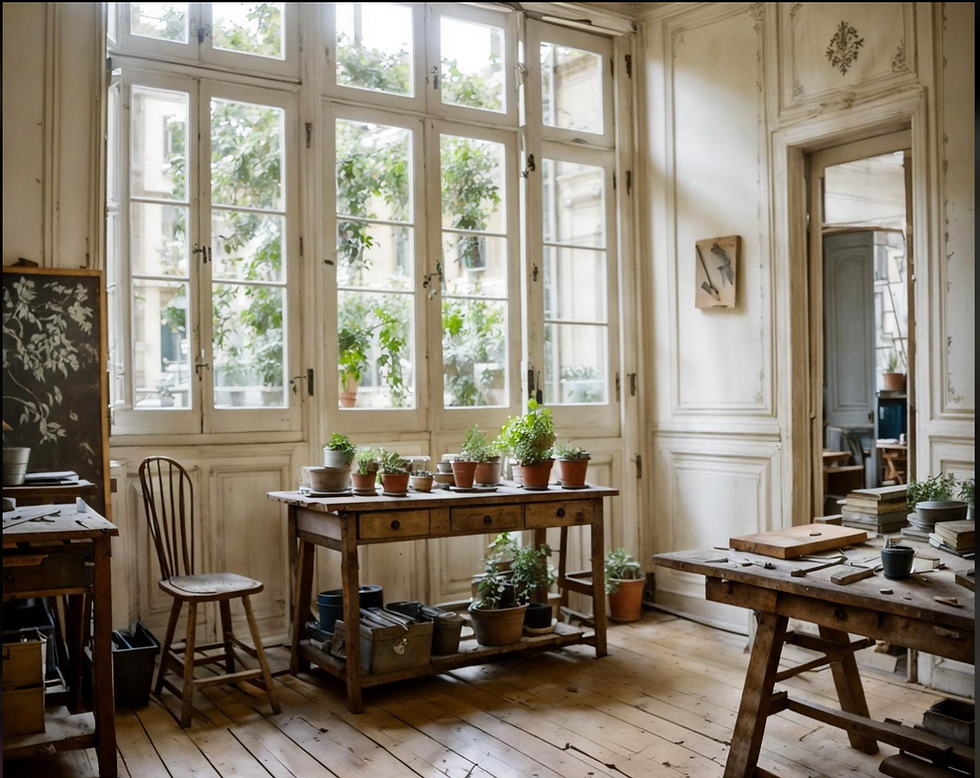
A Port in the Storm: The Role of Magazines Now, November 2025

The death of publishing has been a protracted subject. Every year a fresh set of doomsayers appears in online columns to announce that soon we will abandon anything printed on a weekly or monthly basis, or anything that does not live entirely on the internet. It has long been a bugbear of mine. As I have admitted before, I am a luddite and proud of it. You have to be made of rather dense material these days not to feel sceptical about the motives of the tech world. One of those motives is the scraping of any half-decent piece of writing and the regurgitation of it for the casual reader, all while neatly avoiding credit to the publication that researched and paid for it (à la Google). Combine this with the pitiful sums now needed to push products at consumers through the data-harvesting perfected by Meta over the last twenty years, making it so easy to bypass traditional advertising, it becomes easy to believe that magazines are kaput. I think quite the opposite.
Let us consider that great behemoth, Meta. I no longer use Facebook but WhatsApp and Instagram still make regular appearances in my daily life. Instagram in particular became a central tool in the interiors world. In its early days it was a revelation. It connected us, introduced new designers and makers, and created a lively space filled with possibility. Designers shared glimpses of projects and you might discover an upholsterer by accident. Looking back, we took it for granted, oh how naive we were.
In recent years it has fallen from grace. Its obsession with market dominance and its terror of being overtaken by TikTok has produced a peculiar imitation of its rival. Those of us who once opened the app to see friends, perhaps a new wallpaper or the occasional dog are now confronted by sponsored post after sponsored post, each accompanied by jarring soundtrack. Add to that the arrival of AI-generated videos and images and the experience becomes positively draining. I love interiors and I adore thel people behind them. A straining bookcase speaks of years of collecting. A sofa softened by generations of weighty bums carries a family history. Ceramics are found, made or inherited. Yet AI sweeps all these human nuances into its gulf and regurgitates at a whim to create a look of ‘cottage core’ and more such twee delusional interiors. The comments beneath these images make me recoil, ‘dreamy’, ‘goals’, ‘one day’. Many viewers do not seem to realise these places are completely imaginary, or worse, they realise and simply do not care.
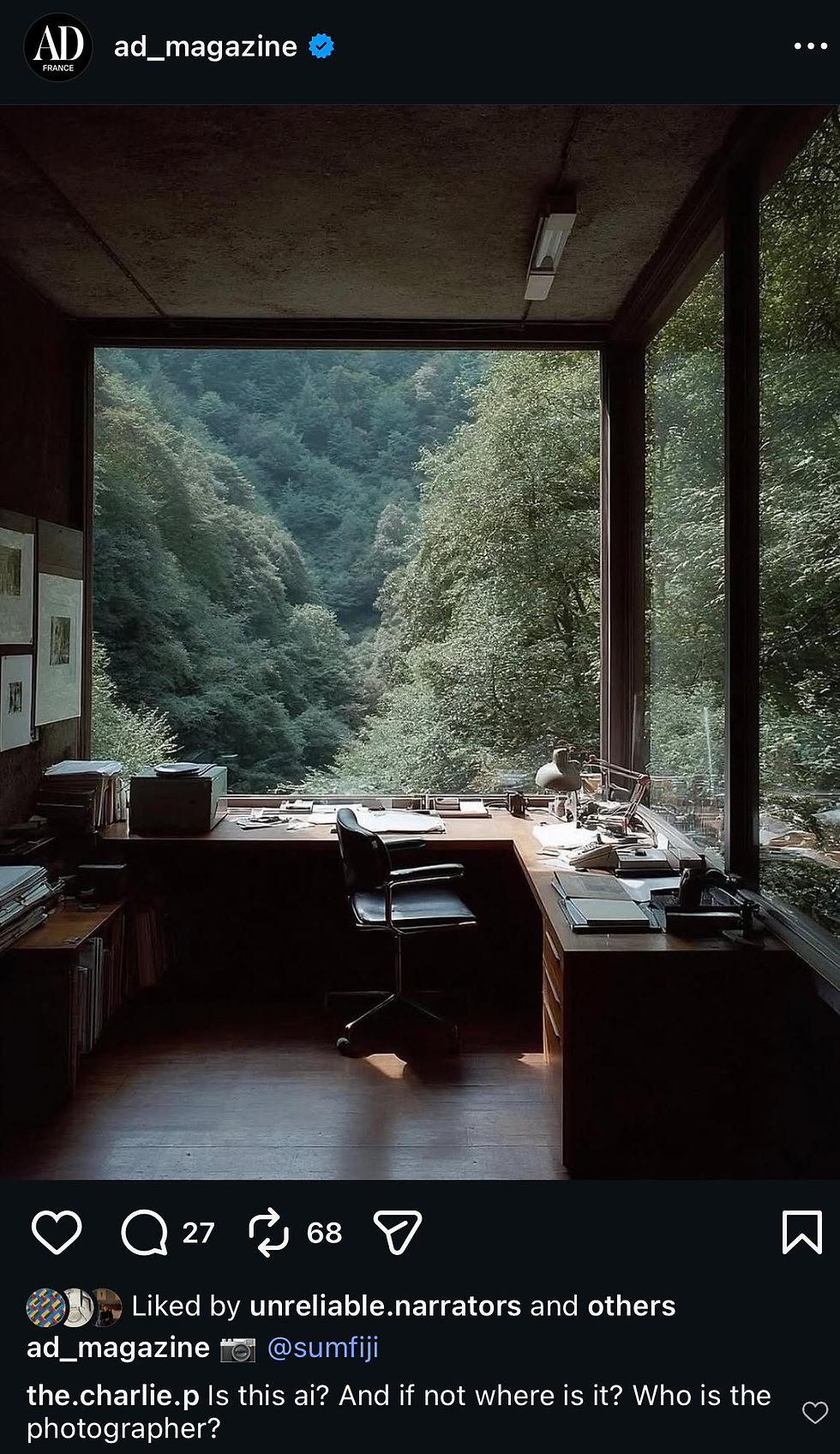
Which brings me to this morning, when I opened Instagram on the bus and saw Architectural Digest France presenting an AI-generated office. Concrete floors, large windows and a forest beyond. The usual comments followed. The whole thing made me angrier than I would like to admit for a Monday morning. If a publication of that stature is sharing such material it risks losing its footing as an educator and a curator of taste, craftsmanship and beauty. The imaginary office may appear attractive, but only if it exists. We cannot give up human work for fantasies that were never touched by a person, but rather created by parasites of human creativity.
If I were a magazine editor, mores the pity, I would be taking this moment to cement myself as a beacon of human made beauty. This is directed solely towards design led publications, others have their crosses to bear but that is not my focus at the minute. The readers of these magazines need to feel safety in the coming years. These publications need to feel like a port in the storm of AI, lashings of hideous news and waves of hardship. Yes, sometimes the interiors they focus on are exceedingly expensive and have about as much footing in our reality as AI, but one must remember the elements that go into those rooms. The mouldings on the ceiling, the hand printed wallpaper, the trim on a curtain, each of these elements has the hand of a person, a business, a livelihood. If editors and online editors start to lose sight of that fact then they cannot blame their readers for feeling they are being fed dross and for putting the magazine down in favour of lesser mimicry.
As the enshittification of platforms continues, meaning the gradual decline of once-valuable online spaces in favour of profit rather than users, we must remember that we control our attention. Editors must make themselves invaluable through proper research and a belief that journalism and genuine beauty remain important. Our minds deserve more than an endless stream of hollow content. We want the story of the collector of Sussex lustreware or the man who in the day ferried his way through the canals of the Netherlands, and at home created lively pastoral frescos, so gracefully illustrated in The World of Interiors.
While the internet slowly devours itself and search engines prioritise the highest bidder, the answer becomes clear. We should return to magazines. We should give our eyes a rest. We should take comfort in pages created with care and integrity. They may prove more important than ever.