
Updated: Jan 10, 2025
When life demands upheaval, the best response is sometimes to hit the road—preferably in an electric vehicle, with no rigid plans and a map filled with possibilities. Ros Byam Shaw recounts a spontaneous journey through France, a trip shaped as much by practicalities—house moves, a new commitment to driving over flying—as by a spirit of curiosity. What began as a somewhat chaotic escape evolved into a masterclass in savouring the unexpected: empty roads, end-of-season charm, and some of the country’s most enchanting sights, from medieval tapestries to towering cathedrals. This is France as experienced without a blueprint, where the detours are as memorable as the destinations.

Goose Fat Roads and Medieval Marvels:
Ros Byam Shaw Takes Us On Driving Through France
9th January 2025
We spent October driving the length of France and back - the longest, least-carefully planned holiday since adolescence. Timing was dictated by the completion on the sale of our house and how fast we could civilise the new one, which was filthy. Making the trip up as we went along was because we had no time or energy for planning. And we drove because we have decided never to fly.

All the above, including taking our EV, turned out to be good things. The roads - most of which are so smooth we joked they must mix their tarmac with goose fat - were empty. Even the most popular tourist sights - Mont St Michel and the Bayeux Tapestry for example - were free from queues and crowds. The weather was kind - only three days of rain, and warm by the time we got as far south as Albi. Everywhere we stayed, whether hotel or B&B, had a charger, and every small town had one or more in its car park. And it cost about £350 of electricity to drive over 2,000 miles.
Making it up as we went along was easy and fun. We took recommendations from friends and Instagram, and plotted a route on the map to include places we wanted to see, while keeping an eye on the weather. Because it was end-of-season we could take our pick of accommodation, whether hotel, B&B or Airbnb, and find a table in popular restaurants - though such is the French devotion to dining that the best places were often nearly full even on weekdays. The longest we stayed anywhere was three nights in three different central city Airbnbs in Tours, Albi and Avignon.
So much for the practicalities. What did we see, and what would I recommend? France is bursting with historic and architectural marvels. Driving means you can turn off if a sign, a distant turret, or something on the map catches your eye. It also reminds you just how big and relatively sparsely inhabited a country it is. The A roads which you pay for are fast and efficient, but fully to appreciate the varied landscape, whether the rolling fields and forests of Normandy, or plunging gorges and steep forests of the Ardeche, there is nothing like riding through it at your own pace. The road from Les Vans to Issoire was particularly memorable.
We took in many famous sights, some unexpectedly marvellous like the Bayeux Tapestry which has an intimacy in real life that no image can convey. Far less well-known but not-to-be-missed is the stupendous Tapestry of the Apocalypse, another extraordinary survival from a few hundred years later. It is huge, and full of fascinating imagery and details of life in the late 14th century. Well worth a visit to Angers where it is housed in a hulking great castle which is a spectacle in itself.

Heading south from Alencon to Tours we made a detour to visit the Proust Museum in Illiers Cambray - a town so significant in his work that its name now incorporates its fictional pseudonym, ‘Cambray’. The terraced house where his madeleine-dipping aunt lived has been restored and is atmospheric - remarkable for being so ordinary a source of inspiration for literary genius.
No sight-seeing trip to France would be complete without its bevy of chateaux. We visited several, always hoping to find ones that were lived in rather than museums. Of the latter, Beyrac has some splendid if empty spaces, two excellent medieval loos, a kitchen with a cobbled floor, and the room where Richard the Lionheart slept when he visited this part of France, plus spectacular views.
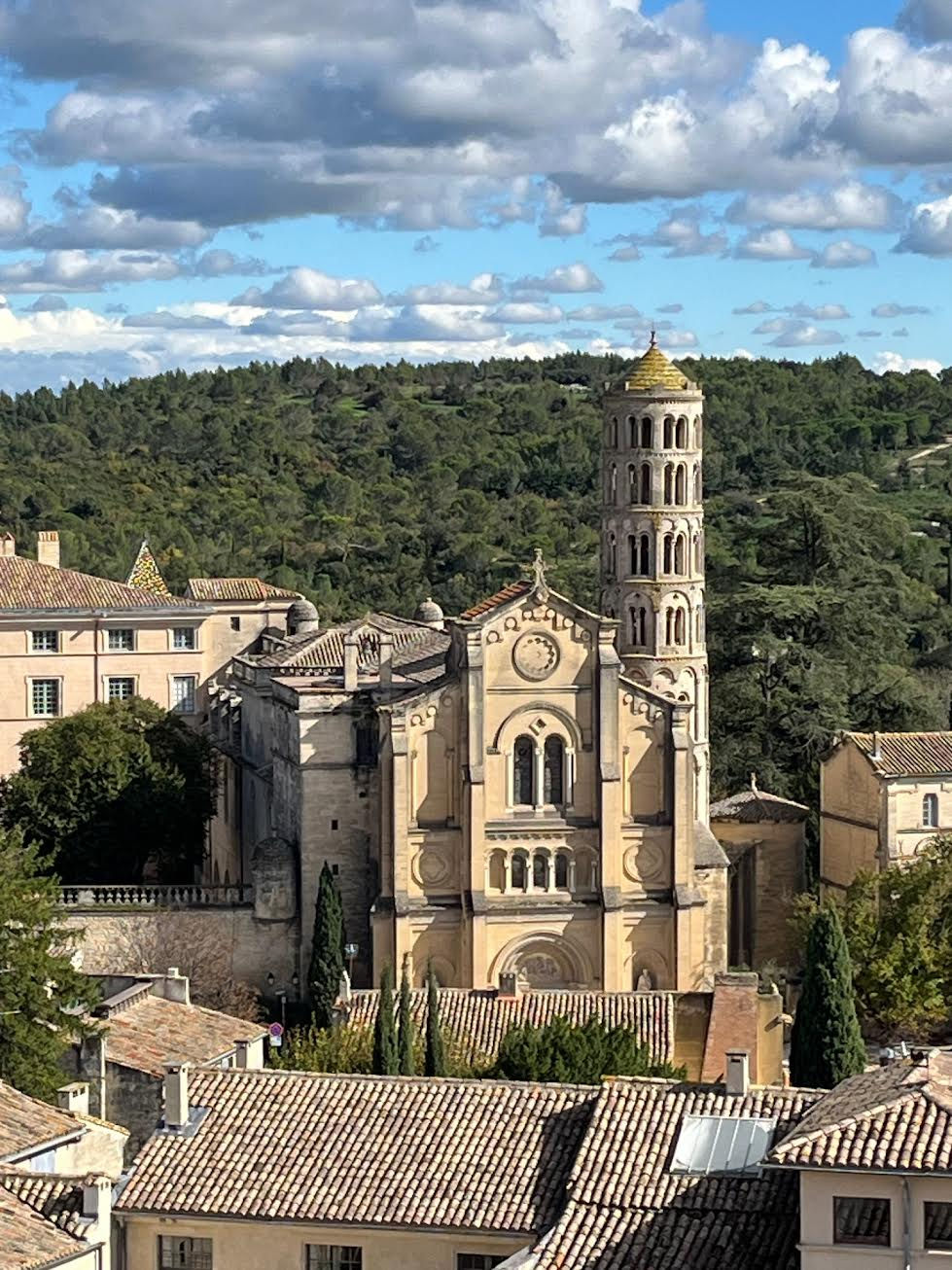
Puy Martin is still lived in and has some prettily-furnished rooms. Likewise Chateau d’Islette which has a fabulous first floor great hall with painted panelling, ceiling and fireplace dating from the early 17th century. I’m not entirely sure I could recommend the rather expensive guided tour of the Chateau Du Duche in the centre of Uzes. We were shown around by a lady so fierce and humourless that our small group was struck dumb, shuffling behind her like nervous schoolchildren. But one of the rooms contained a striking pair of 15th century portraits which she claimed were thought to be ‘the earliest known paintings on canvas’ as opposed to wood. You weren’t allowed to take any photographs but I managed to snatch a sideways snap when she wasn’t looking, while trembling in my sandals.
Painted Great Hall at Chateau D’Islette & The Salon and a Bedroom in Chateau Puy-Martin

Just as unmissable are the abbeys and cathedrals, every one of which offers something remarkable. Bayeux has a crypt of painted angels. L’Abbaye de Fontevraud houses the gorgeous painted tomb effigies of Eleanor of Acquitaine, Henry II, Isabelle of France and Richard the Lionheart, and there is a fascinating Romanesque kitchen with a roof like a scaly chimney-ed witch’s hat. The cathedral in Troyes has huge expanses of jewel-bright medieval glass and a Treasury full of medieval wonders including two embroidered alms bags dating from the 13th and 14th centuries. L’Abbaye de Montmajour, vandalised in the Revolution, still has glorious cloisters and an eery spattering of empty graves cut into the rock. In Issoire Cathedral there is a fantastic 15th century Last Judgement in the narthex which graphically illustrates being wheeled to hell in a handcart.
Two cathedrals stand-out for sheer, jaw-dropping awesomeness. Albi is one. This towering brick building, lobed like a vast jelly-mould, could just as easily date from the 1930s as from the 12th century. It is unlike any medieval building I have ever seen, astonishing for the boldness and simplicity of its design, mind-boggling for the number of hand-made bricks it consumed. The austere exterior explodes inside in a festival of gothic colour and ornament, with painted walls and vaulting, a giant Last Judgement, and the laciest, prettiest stone tracery imaginable.
Albi Cathedral Albi Cathedral Albi Cathedral
Albi Cathedral

Then there is Laon. This extraordinary edifice can be seen from miles away, high on a hill. When we first spotted it, tiny in the far distance, it looked more like a cement works or power station than a building dating from nearly 800 years ago. In fact it wasn’t until we were close enough to see it in more detail that its five pierced towers started to take on a more historic appearance. Close-up it is just as astonishing. Built in a mere 30 years between 1150 and 1180 it is 67 metres high even without its original steeples - one of which crumbled in an earthquake, the other was destroyed in the Revolution. Most surprising of all, balancing on dizzying ledges and gazing implacably out from its pierced colonnaded heights there are 16 life-size stone oxen. It is said to be the most beautiful of all France’s many beautiful cathedrals.
On a smaller scale, churches and chapels worth seeing include St Michael’s in Puys-le-Valay which teeters on top of a volcanic outcrop and has a pleasingly simple painted interior, and the 17th century church in Uzes with its glorious 12th century bell tower, and interior with fabulous ironwork balcony and stair railings, plus a particularly splendid 18th century organ. And in Troyes we loved St Pantaleon which is small but packs a visual punch due to the number of 16th century stone statues brought here after the Revolution, including a couple of life-size renaissance gentlemen looking down from a balcony.

Some of the small museums were excellent. Everyone goes and has a dance on the bridge at Avignon and probably wanders the giant, megalomaniac rooms of the Pope’s Palace. But the Musee Petit Maison next to the Palace was empty, and contains a chronological collection of mainly Italian art dating from the 13th to the 16th centuries. There is even a Botticelli which you can examine at close quarters and sit contemplating in complete solitude (perhaps not in high season) - quite something to have a Botticelli all to yourself. Also in Avignon we liked the Musee Calvert which is housed in an elegant 18th century mansion on a quiet street. Highlights for me were a 16th century enamelled wall mirror, and a brilliantly witty 17th century trompe-l’oeil easel complete with oil painting, palette, brushes and a couple of crumpled engravings pinned to it. The biggest surprise was the museum in Laon next to a recently restored chapel of the Knights Templar. You had to ring a buzzer to be allowed in to find rooms full of Greek, Roman, Bronze Age, Iron Age and medieval artefacts worthy of the British Museum. I was particularly fascinated by a 15th century visor and a pair of enormous Iron Age fire dogs.

As for towns, two of the best we visited were on our way back north, east of Paris. Beaune is elegant and remarkable for its 15th century Hotel-Dieu, built as a hospital for the poor, and still being used as a nursing home as recently as the 1970s. It is architecturally charming with a half timbered courtyard and steep roofs decorated with a pattern of coloured tiles. The room of the poor is like a church interior, its walls lined with front-to-back four poster beds hung with red curtains, each with its own bedside chair and table. There is a kitchen, an apothecary, and best of all a magnificent, glowing altarpiece by Rogier van der Weyden commissioned by the founders for its chapel.
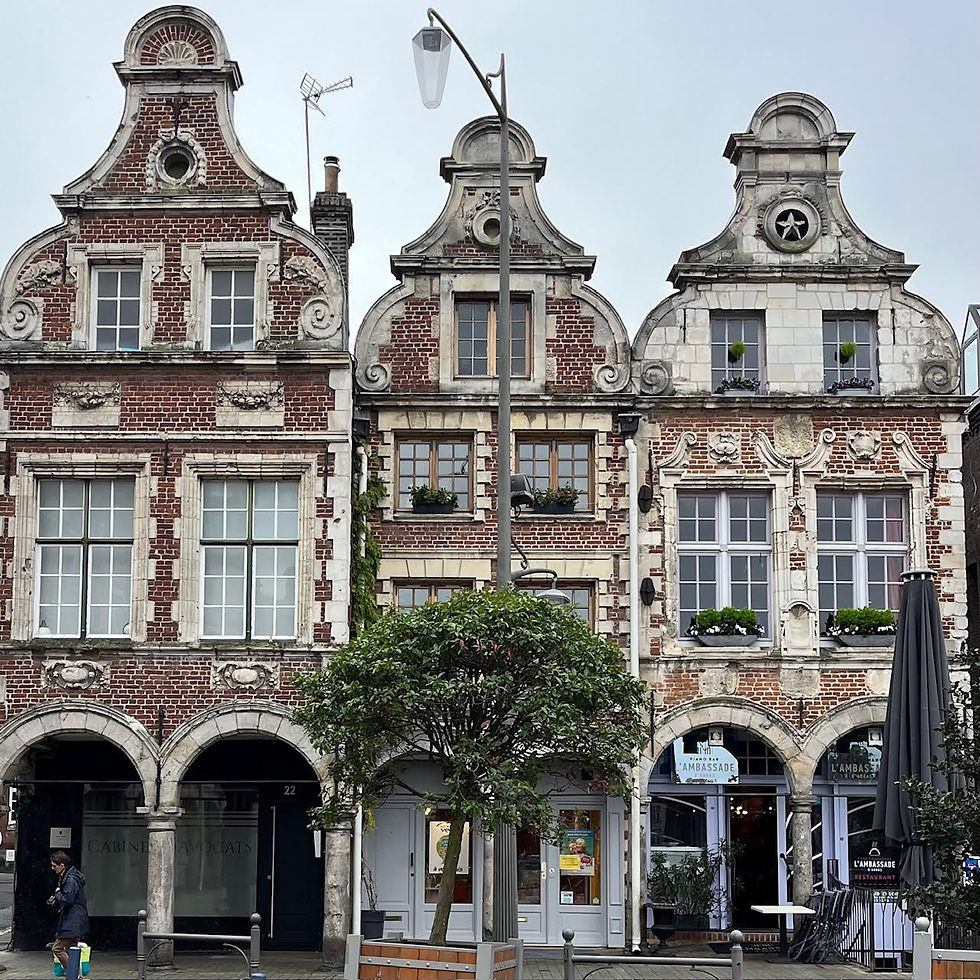
Then there was Troyes, another incredibly well-preserved medieval city with street upon street and cobbled alleys of jettied, half-timbered houses, many with hooded gables, and dating from the 14th to the 17th century. Squeezing down one of the narrowest, known as Ruelle des Chats, or cat alley, the jetties of the houses on either side almost touch above your head and are held apart by timber beams. It is like York’s The Shambles times a hundred. Our last stop was Arras with its two enormous squares surrounded by tall houses with Flemish-style ornamental gables. Almost entirely destroyed by two World Wars these have been so well reconstructed it is hard to imagine that not so long ago they were little more than heaps of rubble.
Back in England, the journey was all rain, heavy traffic, then pot holes as we neared home in Devon. Arriving late afternoon, it would have been nice to go out for dinner, except that small provincial towns in this country don’t tend to offer much choice. Vive la difference and all that. But I do wish we could mend our roads.


