
- Oct 8, 2024
- 11 min read
Updated: Oct 9, 2024
Discover the timeless beauty of trompe l'oeil marbling and decorative painting, as Charlotte Becque explores talented artisans who can transform your space into something truly extraordinary. Learn how you can bring a touch of marbelous craftsmanship into your own home.

When you visit Sandycombe Lodge, it’s impossible not to notice the epic trompe l'oeil marbling that adorns the hallway and stairwell—it’s truly stupendous. Seeing it made me want to gather a group of exceptional decorative painters to help us create our own marbled hallway, or perhaps something even more extraordinary.
I enlisted Charlotte Becque to track down these incredibly talented individuals, diving deeper into the world of murals and decorative painting, so that perhaps one of you can create something equally marbelous.
Where do you find inspiration for your designs? Do you follow trends or focus more on timeless styles?
Every client brings with them a rough idea of what they want, and my job is to focus on that and progress their ideas into reality while offering alternatives that might suit the space and light better. I think we are all influenced by trends, especially in the use of colours, but while being aware of what is fashionable, we should not get trapped and still produce work that can stand the test of time.
Can you share a favourite project or one you’re particularly proud of and explain what made it special?
This is a difficult one to answer because some of my favourite projects have been the most challenging technically but not necessarily the most popular so if I had to choose one it would be for the all round experience.I have just come back from 6 weeks painting in Montecito, California, the house was in the most stunning location perched in the hills with ocean views, the client both talented and generous and the project itself a stylised mixture of ‘art deco’ and ‘chinoiserie' influences with backgrounds of interlocking faux wood work being traversed by gold leaf antiqued rays of varying intensity and topped of by contrasting white cranes flying over the background, there was not a moment I did not enjoy that project.
Have you noticed any emerging trends in decorative painting or finishes that are gaining popularity?
We are living in very eclectic times as far as decorative fashion is concerned. For some years, ‘chinoiserie' feature walls seemed to be more popular, but every single recent project I have had has been very different. Thankfully, I never know what is coming next. You can see the Montecito project and many more examples of my work on my website or Instagram.

Where do you find inspiration for your designs? Do you follow trends or focus more on timeless styles?
My designs usually develop from conversations with the interior designers, architects, or clients. I have been doing this for a long time, so I have a pretty extensive archive of material for ideas.
Can you share a favourite project or one you’re particularly proud of and explain what made it special?
I take a traditional classical approach to mural painting, in part because that is how I enjoy working and also because it harmonizes better with the architecture of the vast majority of interiors. That said, I have done murals in the Art Deco style, Chinoiserie, Trompe l'Oeil, etc.
Have you noticed any emerging trends in decorative painting or finishes that are gaining popularity?
I am bound by privacy agreements in many cases so I can't share details of most recent projects. In decorative finishes, lacquered surfaces are very sought after, but extremely difficult to achieve, and I certainly don't get involved with them.

Where do you find inspiration for your designs? Do you follow trends or focus more on timeless styles?
My first inspiration is my client, I enjoy getting to the heart of exactly what they want, even if they are not able to describe or illustrate it precisely. We look at past projects I have done, we discuss at length what they like and I try to get to the essence of their personal style and taste.
I don’t particularly follow trends, although my clients often do, and this can take my work in new directions, which is fun. I use classical painting techniques, and I think I could describe my style as timeless because I have painted murals in public places that are still extant a very long time ago.
Can you share a favourite project or one that you’re particularly proud of and explain what made it special?
My favourite projects involve trompe l’œil, tricking the eye. I just love it if someone thinks that something is there when it isn’t. I have done a lot of trompe l’œil and I am not always there to see the results. I once did a trade stand and I painted a trompe l’œil fireplace that someone tried to lean on and also painted two cigarette butts on the floor near the edge of the stand, visitors, very kindly, surreptitiously tried to kick them away.
Apart from trompe, I am very proud of the work that I did in the Great Gallery of the RAC Club in Pall Mall, I painted many panels for this dining room, depicting music from around the world. For the private dining room I painted fin de siecle diners with panels of decorative compositions of fruit and vegetables in muted colours below.
I also love it when I am given a project where I paint every wall and ceiling, usually not the floor, although I have done several painted floors.
Have you noticed any emerging trends in decorative painting or finishes that are gaining popularity?
Murals are having a renaissance, there is a trend for flowers and repeated pattern, cottagey decoration as well as Bloomsbury chalky decor, very lovely in the right houses. Exotic landscapes are popular and I love painting these. The beauty of commissioning a mural is that it is so personal to the client, even in commercial sitiations, and to me.
I have painted a trompe l’œil cabinet full of objects that tell the story of my clients interests and passions, bookshelves with the same theme, a “Victorian” train interior with each window depicting the clients family history for a large but not very tall downstairs loo. I can include anything, either an entire life story or small personal elements; a pet; a child; their special landscape or a private joke, anything they wish.
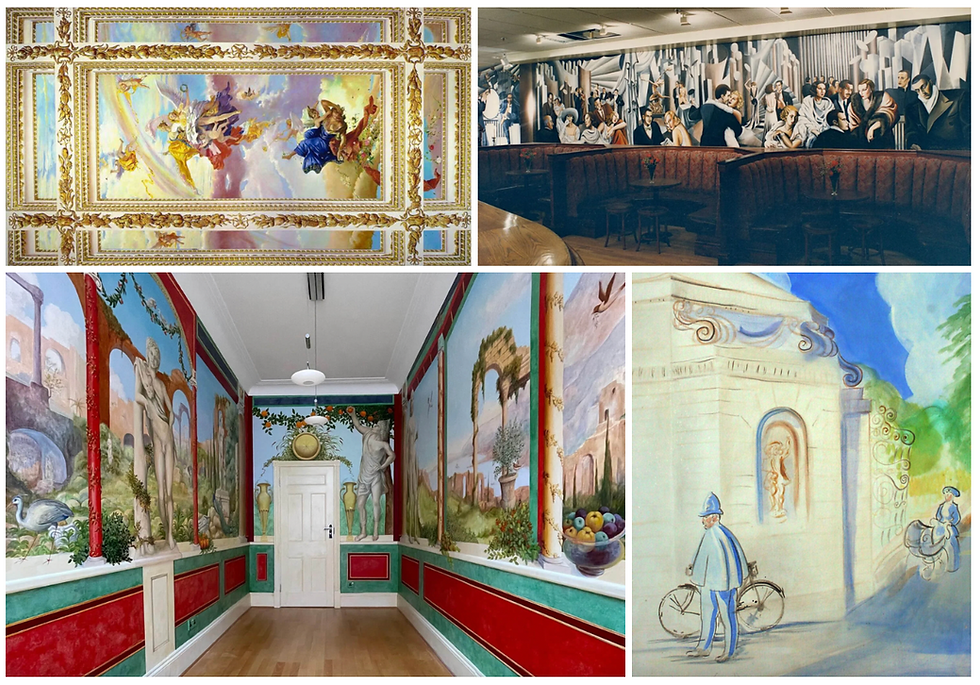
Where do you find inspiration for your designs? Do you follow trends or focus more on timeless styles?
I find inspiration anywhere and everywhere. Recently, I went into the V&A and was so overwhelmed with ideas, I had to leave. Places like the William Morris House and Red House are also sources of inspiration. I’m drawn to paintings, as well as colours and shapes. My style is quite traditional—my work in the 90s was very classical and carefully studied. These days, my murals feel much looser and freer. I usually start with chalk, then layer in paint, adding a bird here or a flower there as I go.
Can you share a favourite project or one that you’re particularly proud of and explain what made it special?
I love the current ones, especially the bakery I have done in Chelsea. There was one I always loved in the early 90s, but I can’t say anything more about that project. I love playing with inlaid wood, and I have a dark rosewood table at home. I love to add a bird or book.
Have you noticed any emerging trends in decorative painting or finishes that are gaining popularity?
I’ve always been inspired by designers like Nicky Haslam and Rifat Ozbek, both in fashion and interiors. The 90s were such an exciting time for both fields—full of creativity and fun. Right now, there’s a real buzz around Charleston House murals and early modernism; they’re incredibly trendy and playful. On the other hand, there’s de Gournay, which offers a more meticulously crafted, elegant contrast to that freer style.

Where do you find inspiration for your designs? Do you follow trends or focus more on timeless styles?
I tend to find my inspiration in mural painting and decorative paintings of the past, particularly 18th-century Italian ( Tiepolo) , Swedish ( Lars Bolander) and French ( Jean Pillement) decorative paintings. I have a large library of reference books that I come back to time and again, and I often use references from other paintings in my work. I like to think that my style is timeless and I don’t follow trends, however to a certain degree I think one can’t help be influenced by current fashions in terms of colour and scale. Everything is absorbed one way or another.
Can you share a favourite project or one that you’re particularly proud of and explain what made it special?
The project I’m most proud of is my exhibition ( about to open) at Sibyl Colefax and John Fowler. I have a lifelong association with the firm as my father ( George Oakes ) was their head designer and bespoke decorative artist for all of his career. One very special project was a handpainted wallpaper we did together in 1999 for a house in Ireland. It was for a huge room in a pavilion looking out onto a cascade and lovely gardens. It was an unusual chinoiserie landscape with fantasy buildings , water, boats and figures. Really special. Also, I’m just starting a new project for a lovely house in Oxfordshire where my father painted his very first murals with John Fowler in 1955! It feels like life is coming full circle and it’s a really wonderful commission.
Have you noticed any emerging trends in decorative painting or finishes that are gaining popularity?
I think all decorative painting is gaining in popularity, which is fantastic. The colours are much stronger than a decade ago, the imagery is bolder, and the overall effect is more daring. I keep seeing strong green malachite everywhere!

Where do you find inspiration for your designs? Do you follow trends or focus more on timeless styles?
Because I am always painting for others, the inspiration tends to come from them and their interior designers. I can guide them on colours/styles/trends, and how things will look in the room. Colours can differ on site from how they look on samples or in a studio. I am usually given very exact instructions by designers and samples approved before being let loose on the actual wall/piece of furniture. I decide and instruct on any preparation work that needs to be carried out by the decorators on site. Mistakes are expensive and, luckily, very rare. I’m always delighted when painting styles come round again, as invariably there is a twist, so nothing is repetitive, just retro. The next time round, it becomes Vintage, so what was considered quite Sloany, eg sponging/rag-rolling in the 80s, is now quite cool. Obviously, I already have a handle on all the marbling/woodgraining/gilding and decorative painting skills, e.g. tortoiseshell, malachite, and porphyry - I don’t need much revision - and I’ve enjoyed teaching these skills to small classes through the years.
Can you share a favourite project or one that you’re particularly proud of and explain what made it special?
I’ve had some fabulous commissions through the years. I particularly enjoyed working at the Drury Lane Theatre (Andrew Lloyd Webber) when he refurbished it a few years ago. I did some marbling and woodgraining work in the Royal box rest rooms (HRH loo!!). I also antiqued the grisaille panel above the entrance door, which arrived from the US looking very white, so now, with the gentle antiquing, it has an elegant patina.
Have you noticed any emerging trends in decorative painting or finishes that are gaining popularity?
Every job is different, and I love being involved in the stories surrounding them as much as the actual work. At the moment, I’m working on a cosmic ceiling panel for two double-sized bunk beds for young boys, which is great fun.
I’m never happier than painting with my grandson Avie aged 22 months - Thought I would stick that one in too!

Where do you find inspiration for your designs? Do you follow trends or focus more on timeless styles?
I find inspiration all over, mainly from books on historic decorative painting and antique textiles. Collections at the V&A Museum and National Trust houses all over the country also inspire me hugely. I try not to follow trends and to not be too influenced by images doing the rounds on Instagram. It can become a bit of an echo chamber. My main starting point for any mural is seeing the space and working out with the client the atmosphere they want to create, which inform the direction I take. I hope that all of my work has a timeless feel to it, and often even feels original to a building.
Can you share a favourite project or one that you’re particularly proud of and explain what made it special?
I recently painted some murals in the new Diptyque store in Marylebone High Street, with a large Fauvist-inspired landscape stretching across the back wall and another wrapping around the tiled cash desk. Diptyque came to me with a sketch which the founder had painted in the 1960s of a field of wild grasses in the French countryside as my starting point. I loved interpreting another's vision and evoking the same feeling through a different lens, playing with colour in nature.
Have you noticed any emerging trends in decorative painting or finishes that are gaining popularity?
I have been commissioned to paint a lot of tonal murals recently, where I only use one colour and create the whole mural using washes. I think the effect is perhaps more sophisticated and contemporary than some murals can feel. We painted a plaster pink tonal mural in Akub restaurant in Notting Hill, and more recently a blue tonal mural in a private dining room at Glenrothes whiskey distillery in Scotland, with the highland landscape appearing through the misty atmosphere it creates.

Where do you find inspiration for your designs? Do you follow trends or focus more on timeless styles?
A great deal of our inspiration comes from collaborating with interior designers, who often bring their ideas and preferences to the table. For instance, they may have a client who loves the colour or texture of a particular fabric and wants to replicate something similar as a design on their walls or ceiling or furniture.This collaborative back-and-forth is where much of our creativity is sparked. Additionally, social media now plays a significant role, providing insight into contemporary trends and fashion, which can also steer design in interesting directions.
For our natural finishes and painted renditions of materials like marble, stone, and wood, I draw direct inspiration from nature, always aiming to highlight the best elements of these patterns. While nature presents its inherent beauty, painting allows me to select and emphasize the finest aspects of the design. In addition to nature, I draw inspiration from history, historical art, and the textures of everyday materials, blending these influences with current trends when appropriate. My focus is on capturing the essence of organic elements in a way that feels timeless, while being adaptable for both classic and contemporary interiors.
Sustainability has always been a core value in my work. I have been instrumental in the UK’s transition from solvent-based to waterborne paints and have traded as a ‘Green’ business since 1996, believing in caring for the planet, our clients, and my team. We combine traditional methods with contemporary products, always prioritizing the finest materials while minimizing solvent use. This commitment led to the innovation of our unique waterborne 'HV'ART Lacquer Paint' system. I strive to create designs and finishes that feel timeless and enduring, as well-crafted finishes should stand the test of time.
Can you share a favourite project or one that you’re particularly proud of and explain what made it special?
It’s difficult to choose a single favourite project, as we’ve been fortunate to work with many wonderful clients and designers on a range of exceptional properties. We take great pride in both our clientele and the projects we’ve completed for them. One standout project for us though was a villa in the Seychelles, where we were asked to create a natural wood ceiling in the master bedroom. The ceiling was originally thatched with palm leaves, which, while beautiful, came with one tiny drawback—creepy crawlies occasionally dropping in for a visit at night. Understandably, the client wasn’t thrilled with this surprise guest list! so we were more than happy to transform the space into something stunning, minus the nightly insect parade.
Have you noticed any emerging trends in decorative painting or finishes that are gaining popularity?
For us the trend has been towards our 'Contemporary Japanning Lacquer' high gloss design for walls and ceilings. These designs/ finishes are created using our waterborne lacquer paint system, making them not only visually stunning but also environmentally friendly. By blending traditional techniques with our soft passaggio finish beneath the lacquered surface, we achieve a glazed, ceramic-like effect that exudes depth, richness, and a soft, watery vibration. The finishes evoke the essence of traditional Japanning lacquers but with a modern sensibility, offering both aesthetic beauty and sustainability. Lacquered walls are bold and dramatic, but the process is not for the faint-hearted—either for the client or the craftsman. The labor-intensive creation requires precision and skill, but the result is unforgettable. These finishes create exciting interiors full of energy, depth, and soul, demonstrating the perfect balance between sustainable innovation and craftsmanship. Here is our webpage to give you some examples of these designs & finishes.


